Showing posts with label TUTORIAL. Show all posts

Thursday, June 2, 2011

The no.2 Pencil Softie -- TUTORIAL!

There's something about oversized or undersized objects that just tickles me... and today's project is certainly no exception!


So... just how oversized IS the pencil softie?
......


Here it is with its regular-sized counterpart!
Hee hee!

Want to make one?
C'mon, you know you want to!


What You Need:
Fleece
(scraps will do! I chose classic pencil yellow, grey, black, tan, and pink)
Sewing Machine
Polyester Stuffing
Needle and Thread

STEP ONE:
Cut your fleece as follows:
yellow: 9"x5"
grey: 2"x5"
pink: 1.5"x5" + a 2" circle
black: small scraps
tan: (see step two!)


STEP TWO: Cut your tan piece. Begin by folding your yellow piece in half, long sides together. You will fold your tan fleece and place it next to the folded yellow piece, with the fold at an angle and cutting at an angle. This does not make sense, I know, until you look at the next photo!


Basically, it is a diamond with its angled sides the same length as your folded yellow piece -- 2 1/2"!


STEP THREE: Topstitch a black scrap to the end of your tan piece to create the lead tip. I cut a curve on one end and sewed along the edge of the curve a scant 1/4" from the edge, then trimmed the angled edges to size. Do not cut away the tan fabric from the back side of your lead tip.


STEP FOUR: If desired, stitch a "no.2" on your yellow rectangle. I used my free-motion foot to "write" it, then cut away the excess with finely pointed scissors. You could also choose to embroider it on once your pencil is completed, using black yarn.

Also attach your grey rectangle, right sides together, using a 1/4" seam allowance.


STEP FIVE: Sew one long side of your pink rectangle to your pink circle, gently matching the curve of the circle as you go and using a scant 1/4" seam allowance. Remember to start and stop 1/4" from the edge of your rectangle.


This is what it should look like when you turn it right side out.


STEP SIX: Sew the other long edge of your eraser's rectangle right sides together to your grey piece, gently pulling the eraser piece around in front of your sewing machine foot as you go -- as shown.


STEP SIX: Attach the tip of your pencil. Line up the edges together for the first half of the tan piece, then stop at the midpoint (with your needle down), lift your presser foot, and turn the tan piece to match the edges of the second half. Put your presser foot back down and sew to the edge.


STEP SEVEN: Finish sewing the pencil together! Line up the straight edges of your eraser and start sewing, matching up the seams as you go. Leave a space about the width between my fingers, as shown in the photo. Then start sewing again, all the way to the point.


STEP EIGHT: Turn your pencil right side out and stuff it firmly with polyester stuffing. Sew together the opening using a whipstitch.


You're done!!

Monday, March 7, 2011

Angry Birds Plushies -- All the Tutorials!

If you are here visiting for Celebrate the Boy -- WELCOME! I'm so glad you stopped by. I hope you'll stick around for a little while!

Today I am sharing my tutorials for Plush Angry Birds.
Click each image below to find the pattern and instructions for the character you are dying to create! All links include patterns and instructions. Each bird is an adaptation of the original red bird, which is where you need to go to find easy step-by-step instructions.


You'll have a whole angry crew to toss around in no time!

!!YAY for boys!!

I have added a new category over in my right sidebar filled with BOY projects --

Be sure to check it out!

Tuesday, March 1, 2011

Barbie Bed -- A Dollar Project!

Hee hee! I am tickled by today's project for Dollar Store Crafts. But, then again, you know me and tiny things -- I just love them! Can you guess the source of my doll bed frame and comforter?


The comforter and pillow were made from a dollar store pillow cover -- with fabric to spare -- and the bed frame was made from two wooden "Zen Garden" trays, also from the dollar store. I have had my eye on those for over a year, knowing they had great potential. Finally the perfect project to use them for!

Here's what I used:
~ One pillow cover (lots of prints and fabrics to choose from!)
~ Two Zen Garden trays
~ Scrap of eyelet trim (for the bed skirt)
~ Scraps of white fabric (for the mattress and bed skirt)
~ Scraps of polyester batting
~ Also need: sand paper or utility knife, wood glue, finish nails, saw

(pardon the lighting on this photo and the next one, taken down within the depths of the basement!)
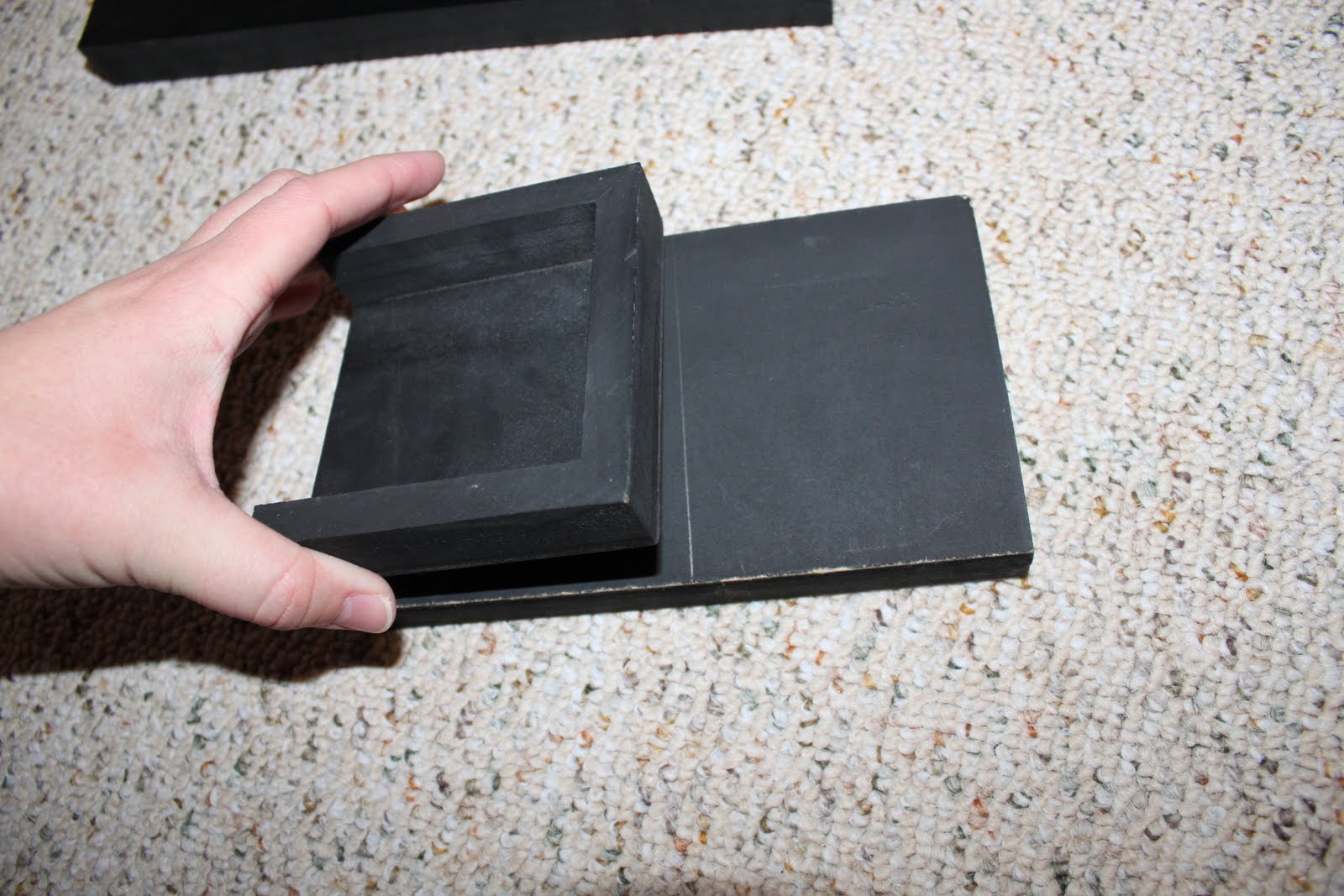
First we will need to construct the bed frame. My husband was kind enough to tackle this part of the project for me!
STEP ONE: Measure and mark ONE of your Zen Garden trays 3 5/8" from one end and carefully saw. The longer piece will be the headboard, and the shorter piece will be the foot of the bed.

STEP TWO: With both cut ends together and the two tray pieces back to back, use a sharp pencil to draw a line on the headboard piece, marking the height of the foot of the bed, as shown.

STEP THREE: You will be butting the shorter end of the first tray (the foot of the bed) against the short end of the second (uncut) tray. The cut side will be the part of the bed that touches the "floor." Lightly sand (or in our case, since we had no sandpaper handy, scrape with a utility knife) JUST the two surfaces that will be touching. This will help the wood glue to hold. Use a thin layer of wood glue, then carefully nail one finish nail on either end for a sturdy hold.


STEP FOUR: Now for the headboard. Again, carefully sand or scrape the two surfaces that will be glued together. Your drawn line will be where you line up the TOP of the long tray. We glued and then used a staple gun to hold the headboard in place.

Allow the glue to dry!

STEP FIVE: Now we're getting to the fun part -- the sewing!
I started by carefully removing the zipper (to save for a future project!) and then cutting along the seam lines of the pillow cover. Set your pillow cover fabric aside.

STEP SIX: Make the bed skirt! Cut as follows:
Center piece: 11" x 4 1/4"
Ruffle pieces: Two rectangles, 14 1/2" x 4"

Hem the two short ends of all pieces, and one long end of each of the two ruffle pieces, by turning the edges up 1/4" and sewing. Gather the raw edge of the two ruffle pieces a scant 1/4" from the edge. Attach to the long edges of the center piece. Your bed skirt should look like the photo.

STEP SEVEN: Make the mattress! Cut two rectangles, 12 1/2" x 5 1/4". Sew all the way around with a 1/4" seam allowance.

Open each corner as shown and sew a line 3/8" from the point, perpendicular to the seam line. This will box the corners of your mattress.

Cut a 6"-8" slit down one the center of one rectangle and turn it right side out. Carefully stuff with a stack of batting and whipstitch the opening closed.

Bed skirt and mattress? Check!


STEP EIGHT: Make the comforter! Cut two rectangles, 9 1/2" x 13 1/2". Layer them right sides together and sew three sides, leaving one short side open. Trim the corners as shown and turn right side out. Carefully tuck the raw edges inside 1/4" and press. Topstitch all the way around, closing the opening as well. Done!

STEP NINE: Make the pillow! Cut two rectangles, 5 1/4" x 3 3/4". Sew right sides together using about a 1/8" seam allowance, leaving a 2 1/2" opening on one short end. Turn right side out.

Topstitch right along the edge on the three finished sides, then 1/4" from your stitching line.

Stuff with another stack of batting. Carefully tuck the raw edges inside and topstitch the opening closed, then sew 1/4" from that stitching line.

Everything's done! Time to make the bed!
I topped my little bed with a tiny embroidered sachet that belonged to my grandmother. It makes a perfect accent pillow!

Barbie is all set to relax and read a book!

Wednesday, February 16, 2011

Tiny Kitten in a Box


What you need:
~ fleece scraps -- black, white, and light and dark of a color of your choosing -- I will call it blue throughout the tutorial
~ thread (I used white for everything!)
~ tissue paper
~ pencil
~ finely pointed scissors
~ free-motion presser foot (optional but highly recommended!)
~ small amount of fiberfill stuffing
~ pattern -- click HERE! (pg 1 = cat, pg 2 = box)

Please read through the entire tutorial before starting -- the cutting directions will make SO much more sense that way!


STEP ONE: Using a pencil, trace the pattern onto your tissue paper. Cut it out, leaving about an inch around the perimeter.


STEP TWO: Cut your fleece.
Important: Be sure the stretch of your fleece runs left to right!
You will need:
2 light blue rectangles the same size as your tissue paper pattern
1 white rectangle large enough to cover the eyes and nose of your pattern1 black rectangle large enough to cover the pupils and nose of your pattern
1 dark blue rectangle large enough to cover the width of your pattern plus the height of the stripes
(You don't need to measure -- eyeball and chop. If all else fails, cut all your pieces the same size as your pattern!)


STEP THREE: Layer as follows:
Place one light blue rectangle right side DOWN. Place your tissue paper on top. Lift it up and place your white rectangle over the area where the eyes and nose will be, then place it back down so the white is on the bottom and the tissue paper is on top.


Like this!


STEP FOUR: Sew around the eyes and the cheeks/chin. I use my free-motion foot for this, but if you don't have one you can do the needle-down-lift-the-foot-and-turn maneuver.


Here's what it will look like on the other side.


STEP FIVE: Using your scissors, carefully trim the excess fleece away from around your stitching lines.


STEP SIX: Layer your black rectangle over the eyes and nose.


Flip everything over to the pattern side and sew around the pupils and nose.


Trim away excess.


STEP SEVEN: Layer your dark blue rectangle over the stripe area of the light blue rectangle. Again, be sure the stretch of your fleece runs left to right.


STEP EIGHT: Flip over and sew the stripe lines. Trim away excess fleece.


STEP NINE: Layer your second light blue rectangle on top of your kitten's face, right sides together.


Flip over and sew on the line, leaving about two inches at the bottom open for turning and stuffing.


STEP TEN: Tear away as much of the tissue paper as you care to -- it doesn't matter if it's perfect because it will all hide inside!


STEP ELEVEN: Trim near your stitching line all the way around except at the bottom opening, as shown.


STEP TWELVE: Turn your kitten right side out, carefully poking the ears out with a blunt object. Stuff her!


STEP THIRTEEN: Carefully poke the seam allowances of the opening inside and hand sew the hole closed. (Look what happened to my apparently very weak needle! I was pulling it straight, and -- pow!)


Voila! A cute little kitten!


You can definitely get creative with colors. Look at these little special-request kittens I made for my nieces and nephew:
It's definitely extra work to give them colored eyes and pink noses, but they just turn out so cute that way!


The box pattern is on page 2 of the pattern file. I tried a few kinds of cardboard, but the cardboard from a pizza box was definitely the best scale.

Best of luck with your kittens!
Please pretty please post photos to my flickr group if you make one! :o)